Jarvis AI Assistant vs ChatGPT:
Which Is Better for Windows?
ChatGPT is excellent at thinking. The gap is doing things on your local machine. Here is a fair look at where each one is strongest, so you can pick the right tool — or use both.
ChatGPT is very good. That is not the question.
If you are searching for a ChatGPT alternative for the desktop, the honest first answer is that ChatGPT is very good at what it does. OpenAI’s models are among the strongest available for reasoning, writing and general knowledge; the product has a large ecosystem of custom GPTs and integrations; and, at the time of writing, it offers a Windows desktop app of its own. If your work is mostly thinking, drafting and asking questions, ChatGPT is a fine choice, and nothing on this page should talk you out of it.
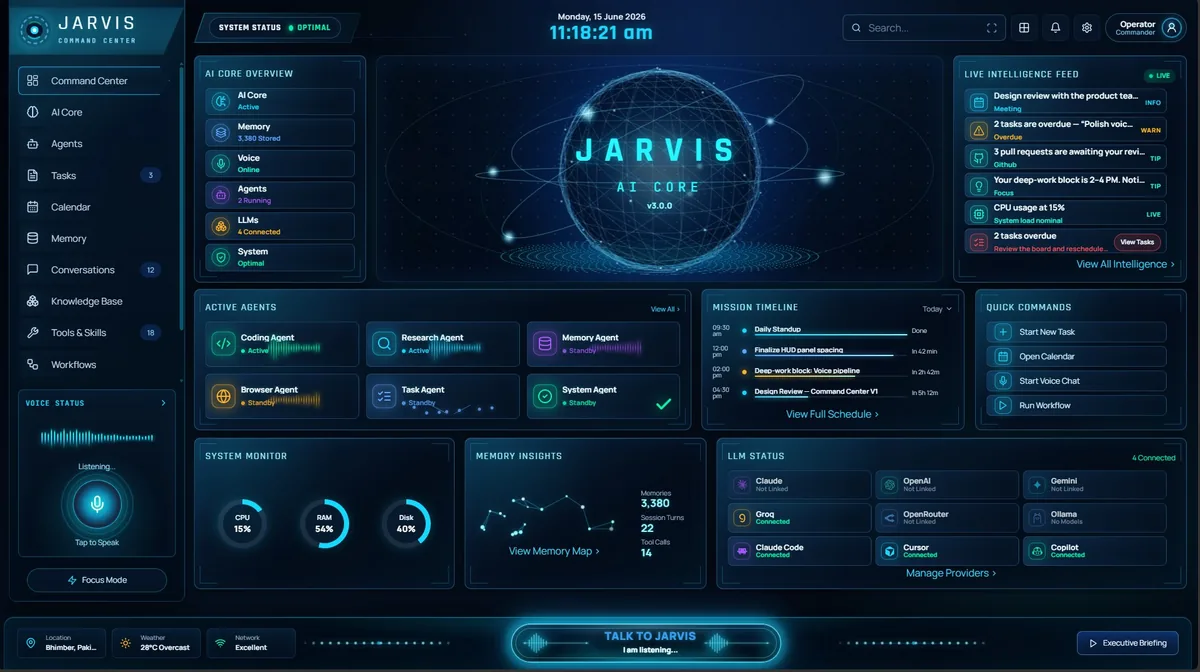
The gap is doing things on your local machine. ChatGPT’s desktop app is, at heart, a window onto a cloud service: it can see what you paste or share with it and reason beautifully about it, but it does not run your shell, read your repository, list your Docker containers, or send the email it just drafted from your own account. Jarvis AI Assistant was built for exactly that layer. It is a native Windows 10 and 11 app from the Microsoft Store that runs more than 75 real tools on your PC, and it uses the model of your choice — including OpenAI’s — to decide which ones to run.
Pick by the shape of your day.
Choose ChatGPT when
- You want a single, top-tier conversational model with no setup at all.
- You rely on custom GPTs, its built-in voice mode, or other parts of the OpenAI ecosystem.
- Your tasks end in text: a draft, an explanation, an answer — not an action on your PC.
- You are happy with one vendor choosing the model and hosting the conversation.
Choose Jarvis when
- The task ends in an action on your machine: a commit summarised, a container restarted, a ticket filed, a reply sent.
- You want to pick the model per request across 7 providers instead of being tied to one.
- You need a fully local mode where nothing leaves your machine.
- You want memory that persists across sessions and lives on your own disk, plus wake-word voice over the same agent.
It is not really ChatGPT versus another model.
Jarvis can route a request to OpenAI when that is the best fit and to a local model when the content is sensitive, in the same conversation. It speaks to seven providers: Claude, OpenAI, Gemini, Groq, OpenRouter, local Ollama models, and the Claude Code command-line tool. You bring your own API keys and pay each provider directly —Jarvis adds no markup on tokens. If you already pay for a Claude plan,Jarvis can drive Claude Code as a provider too.
Where the conversation is processed.
ChatGPT processes conversations on OpenAI’s servers under OpenAI’s terms. What controls you have over retention and training use depend on your plan and settings, and those policies change, so check the current ones rather than take our word for it. Jarvis gives you three privacy modes instead: STRICT keeps everything local through Ollama, GUARDED redacts API keys, passwords and personal data before any cloud call and writes an audit entry, and RELAXED turns interception off for non-sensitive development work. Conversation history and memory are stored on your machine, encrypted at rest. The security page goes into each mode in detail.
Not another chat box.
Most assistants talk. Jarvis executes — on your hardware, across your tools, with memory that lasts.
| Capability | ChatGPT | Microsoft Copilot | Jarvis |
|---|---|---|---|
| Has a native desktop app | |||
| Executes real tools on your machine (shell, git, docker) | partial | partial | |
| Cross-session long-term memory | partial | ||
| Multi-LLM routing (7 providers) — you pick the model | partial | ||
| Fully local / offline mode | |||
| Secret redaction before anything reaches the cloud | partial | ||
| Voice, CLI, Web & desktop — one brain | partial | partial | |
| Auditable agent core (every action logged locally) | partial | partial | |
| Bring your own API key — no markup |
Comparison reflects publicly documented capabilities at the time of writing.
Go deeper
Thinking versus doing — and why many people use both.
For pure conversation quality inside a single vendor’s ecosystem, ChatGPT remains excellent, and it is the right answer for a lot of people. For an AI desktop assistant that actually operates your Windows computer — with your choice of model behind it, your data on your disk, and voice, memory and tools in one agent — Jarvis is the better fit. Plenty of people sensibly keep ChatGPT for open-ended thinking and use Jarvis for everything that touches the terminal, the filesystem or their accounts; the two are not mutually exclusive, and Jarvis can even call OpenAI’s models as one of its providers.
Jarvis is a paid product with quarterly, annual and one-time lifetime plans, all with the same full feature set — details on the pricing page. Install it from the Microsoft Store, add a key for whichever provider you prefer, and follow the usage guide for the first commands and routing prefixes. If you want the wider field, our round-up of the best AI assistants for the Windows desktop covers the rest of the options, and our Copilot comparison does the same exercise for Microsoft’s assistant.