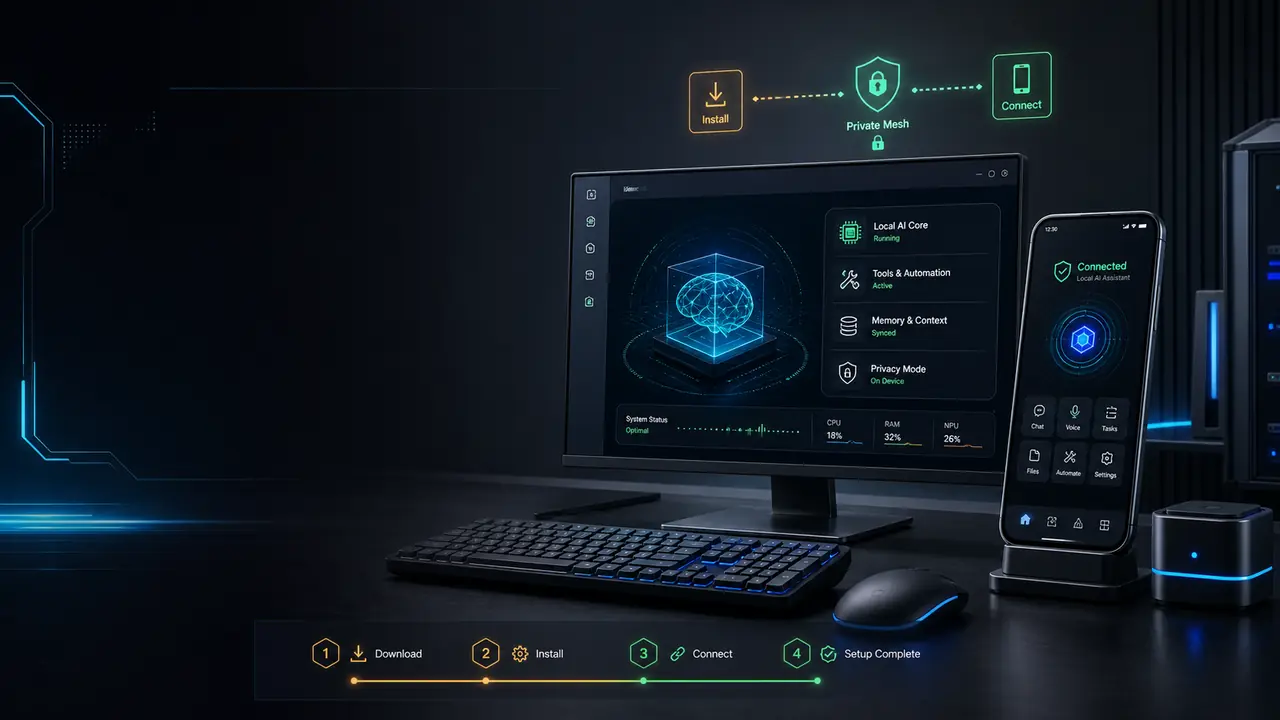
Available Now

Download Jarvis AI Assistant

Run the full assistant on Windows, and take it with you on Android. Same brain, same memory, same tools — everywhere you work.

Windows

Windows 10 & 11
Scan to install

The full native desktop experience — MSIX-packaged Electron app with voice, tray supervision, and the Command Center daily briefing.

  • Windows 10 (2004+) or Windows 11, 64-bit
  • 4 GB RAM with cloud AI models
  • Local AI with Ollama: 8 GB RAM minimum for small (7–8B) models, 16 GB recommended; a GPU helps
  • Docker Desktop only for WhatsApp/Messenger
Get from Microsoft Store
  • Runs real tools on your PC
  • Local-first privacy controls
  • Your AI keys, no token markup

Sandboxed via the Microsoft Store

Android

Android 8.0+
Scan to join the testers

Talk to Jarvis and drive your desktop from your phone. Coming to Google Play — the production release is in review. Want it now? Join the testers.

  • Android 8.0 (Oreo) or newer
  • Tailscale on phone + desktop to connect
  • Sign in with your Jarvis account
Join the testers on Google Play
  • Android companion app
  • Connects to your Windows desktop
  • Works with Tailscale
  • Coming to Google Play

Tap "Become a tester" on the Play page, then install Jarvis from Google Play.

🔐

Connect the app to your machine

The Android app reaches your desktop over a private Tailscale mesh — no ports exposed, no data through our servers. Install Tailscale on both devices, sign in with the same account, and Jarvis links up automatically.

Get Tailscale ↗

Also available as a rich CLI, web dashboard, and voice interface — see the setup guide.

AFTER YOU INSTALL — ~5 MIN SETUP

Installed it? Here's the rest.

A beginner-friendly walkthrough of the first launch, signing in, and giving Jarvis a brain. No developer setup and no Docker for the core app.

01Install & first launch

Open Jarvis and let it boot

Launch Jarvis from the Start menu. A secure-boot screen appears while the local AI core and dashboard warm up in the background.

WHAT HAPPENS ON FIRST LAUNCH
1

Secure boot

Jarvis verifies its local runtime — you see a progress screen.

2

Core starts

The AI engine and dashboard start up in the background.

3

Systems online

Progress reaches 100% and the command center loads.

4

Ready

The main window opens to sign-in. ~10–15s the first time.

First launch is the slow one

The first start takes about 10–15 seconds while dependencies are verified and cached. Every launch after that is much faster because the check is skipped. A small Jarvis icon also appears in your system tray — the app keeps running there so it's always a keystroke away.

02Sign in

Create your account or sign in

On first run Jarvis opens a sign-in page. Creating an account secures your assistant — your data and conversations stay on your own machine.

New here — create an account

1.Click Sign up on the welcome screen.
2.Enter your name, email, and a password.
3.You go straight into a short onboarding wizard.
4.Next, connect an AI model (step 3).

What onboarding covers

👋Welcome — try Jarvis immediately
📖How to use — commands, voice, dashboard
🔑AI keys — optional, add now or later
✅Done — you land in the dashboard

Your account is local-first

Jarvis is a single-user product — one private instance on your machine, not a shared cloud service. Signing in protects access to your assistant; it does not upload your conversations anywhere. Your history lives in a local database on your PC.

03Connect a model

Give Jarvis a brain

Jarvis needs one AI model to think with. The easiest start is a free Groq key; the setup dialog tests it before saving.

⚡

Recommended for beginners · Groq

Free key · fast · nothing to download

EASIEST START

Groq has a free tier and answers quickly, so it works well on any PC. Create a free key, then paste it into Jarvis.

# 1. Create a free key
→https://console.groq.com/keys
# 2. In Jarvis, choose "Connect Groq free key" and paste it

Jarvis tests the key before saving it, so you know it works before your first request.

Alternative · OpenRouter

One key for many models, including free ones.

→https://openrouter.ai/keys

In Jarvis: Connect OpenRouter free key.

Alternative · Gemini

Google AI Studio offers a free Gemini key.

→https://aistudio.google.com/apikey

In Jarvis: I already have a key, then pick Gemini.

Privacy option · Ollama

Install Ollama, then choose Use Ollama in Jarvis. Ollama's cloud models work after you sign in at ollama.com. Fully local models keep everything on your PC but need capable hardware: 8 GB RAM minimum for small (7–8B) models, 16 GB recommended, and a GPU helps.

# Download and install Ollama for Windows
→https://ollama.com/download
# Cloud models: sign in to your free Ollama account
$ollama signin
# Fully local: pull a small model (one-time download)
$ollama pull llama3.1:8b

Add more models later

You can add keys for Claude, GPT or Gemini any time from Settings → AI Model. Not sure what to pick? Choose Use Jarvis recommended model in the setup dialog and it uses what is already available.

04Try a first task

Give Jarvis your first task

You're set up. Jarvis is now one keystroke away, everywhere on your desktop.

Open Jarvis

Type your request in the chat box in plain language.

Go hands-free (beta)

Voice and the wake word are in beta. Turn them on in Settings → Voice, then talk.

Use the dashboard

Chat, Command Center, daily briefing, notes and settings — all built in.

Try these first tasks

›"Show me the files in my Downloads folder."
›"what can you do?"
›"remind me at 5pm to call Sam"
›"take a screenshot"

Talk to Jarvis in plain language — no commands to memorize. Want the full command reference and power workflows? Read the Usage Guide.

05Troubleshooting

If something doesn't look right

The common first-run questions, and the quick fix for each.

The boot screen is taking a while+

The very first launch verifies and caches dependencies, which can take 10–15 seconds. If it stays on the boot screen much longer, close Jarvis from the tray and reopen it — the cached checks make the second launch fast.

It says no AI model is configured+

Jarvis needs one model to think with. Open the model setup dialog and paste a free Groq key (or an OpenRouter or Gemini key), or use Ollama. See step 3 above.

Voice input does nothing+

Enable the microphone for Jarvis in Windows Settings → Privacy → Microphone, then turn on voice in Jarvis Settings → Voice. The mic permission is required before hands-free mode works.

I want everything to stay offline+

Install Ollama, pull a local model, pick it as your model, and set privacy to STRICT in Settings. In STRICT mode Jarvis does not send anything to a cloud model. Local models need capable hardware (8 GB RAM minimum, 16 GB recommended).

How do I update Jarvis?+

The Microsoft Store updates Jarvis automatically in the background. You are always on the latest version with nothing to do.

06FAQ

Install & setup FAQ

Quick answers to what people ask before installing Jarvis.

Do I need Docker, Node.js, or Python to install Jarvis AI Assistant?+

No. The Microsoft Store version is fully self-contained — it bundles its own runtime and runs the dashboard on Electron's embedded Node. The core app needs no manual setup. Docker Desktop is only needed for the WhatsApp and Messenger integrations, and browser automation downloads a small browser driver (about 35 MB) the first time you use it.

Is Jarvis AI Assistant free to install?+

The installer is available from the Microsoft Store at no charge, but a limited-time $9.99 one-time lifetime purchase is required to unlock the full assistant, with no recurring app subscription. AI-model usage is separate: bring your own cloud key and pay that provider directly, or run a local Ollama model with no per-token provider bill. Jarvis AI Assistant adds no markup.

Why does the first launch take a few seconds?+

On first launch Jarvis AI Assistant verifies its local runtime and starts the AI core plus the dashboard in the background, which takes roughly 10 to 15 seconds. The secure-boot screen shows progress. Subsequent launches are much faster because the checks are cached.

Do I have to connect a cloud model?+

No. With Ollama and a model running on your own PC, Jarvis AI Assistant works without a cloud model. Fully local models need capable hardware (8 GB RAM minimum for small models, 16 GB recommended) and are slower than cloud models on modest PCs. Cloud models (Groq, OpenRouter, Gemini, Claude, GPT) are only used if you add a key.

Which model should a beginner pick?+

A free Groq API key: it is fast, needs no download, and Jarvis AI Assistant tests it before saving. Free OpenRouter or Gemini keys also work. If privacy matters most, use Ollama. The setup dialog can also pick an available model for you.

My data — does it leave my machine?+

Your conversations and memory are stored on your PC. Prompts go to a cloud model only if you use one. RELAXED, the default, sends them without redaction; GUARDED strips credential-like strings such as API keys, passwords and tokens first. In STRICT mode only local Ollama models answer, though online tools such as web search still work. You choose the mode in Settings, and a local log records which models were called.