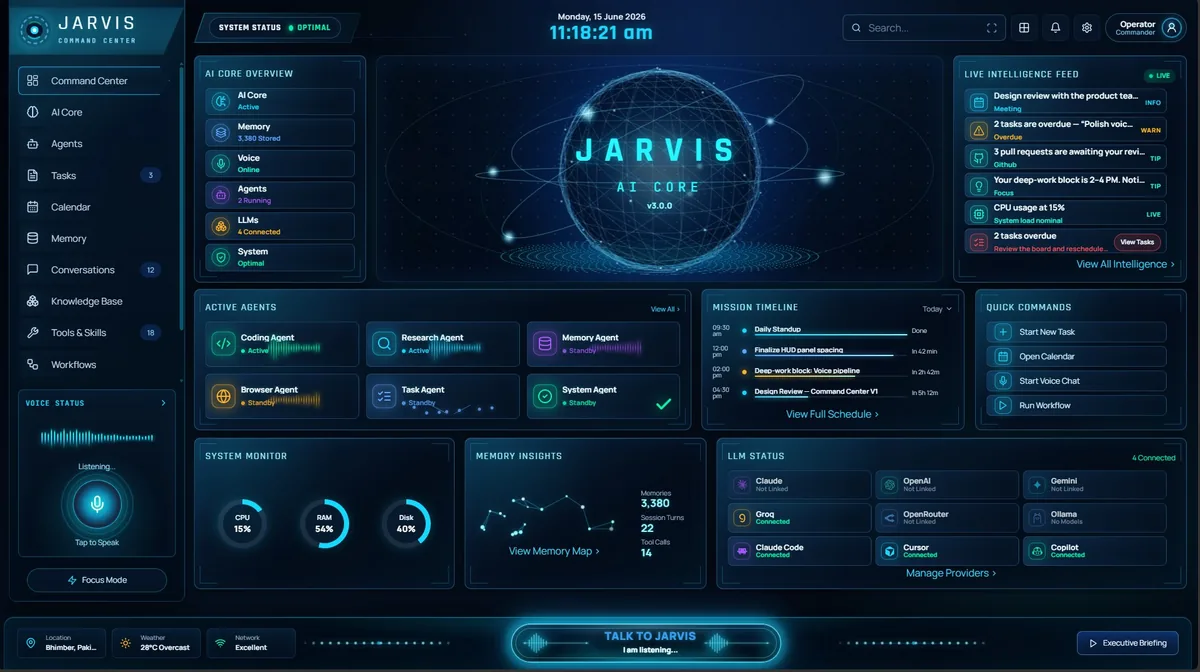
A Microsoft Copilot Alternative
That Runs Real Tools on Your PC
Copilot is built into Windows and Microsoft 365, and it is very good there. Jarvis AI Assistant is a Windows AI assistant for everything outside that world: your terminal, your repos, your containers, your inbox — with the model you choose.
Copilot owns the Microsoft world. The question is everything else.
Microsoft Copilot has one advantage nobody else can match: it is built into Windows and Microsoft 365. It sits on the taskbar, it understands Word, Excel, Outlook and Teams natively, and for organisations already standardised on Microsoft’s stack it is the lowest-friction AI assistant there is. At the time of writing it ships as part of Windows 11 and as paid add-ons for Microsoft 365; if your day is spent inside those apps, it is the obvious first thing to try. This page is not here to tell you it is bad.
The reason people search for a Copilot alternative is usually narrower than that. Copilot is excellent at thinking and talking inside Microsoft’s world, and the gap is doing things on your local machine outside it — the terminal, the git repository, the Docker daemon, the Jira board, the WhatsApp thread, the Gmail account. Jarvis AI Assistant is a Windows AI assistant built for that gap. It installs from the Microsoft Store as a native Windows 10 and 11 app and runs more than 75 real tools on your PC, with the model of your choice behind it.
It reads the log. It restarts the container. It files the ticket.
Tell Jarvis to summarise yesterday’s commits and it reads the git log. Ask which containers are unhealthy and it queries Docker. Ask it to turn the TODO comments in a directory into tickets and it opens Jira. Ask it to reply to a WhatsApp message and it sends the reply. Each call is visible and logged, and a multi-step request runs as one chain rather than a series of copy-and-paste prompts. This is the part a system-integrated chat assistant, however polished, does not do for a developer’s toolchain at the time of writing. The same agent answers by voice when you say the wake word, and it remembers decisions across sessions so you are not re-explaining your projects every morning.
Stay with Copilot when
- Your work lives in Word, Excel, Outlook, PowerPoint and Teams, and you want AI inside those documents.
- Your organisation has already licensed it and governance is handled centrally.
- You want something already present on the Windows taskbar with nothing to install.
Choose Jarvis when
- Your work lives in a terminal, a repo, a container host, a ticket board, or a chat thread.
- You want to choose the model per request — or keep it fully local.
- You want an assistant whose memory and credentials stay on your own disk, with an audit log you can open.
Your choice of model, not Microsoft’s.
Copilot runs on the models Microsoft chooses for it. Jarvis routes across seven providers — Claude, OpenAI, Gemini, Groq, OpenRouter, local Ollama models, and the Claude Code command-line tool — picking per request or honouring a prefix you type. You bring your own keys and pay each provider directly, with no token markup added.
Cloud by default, or local by choice.
Copilot is a cloud service: prompts are processed on Microsoft’s infrastructure under Microsoft’s terms, with whatever data protections your licence provides, and you should read those terms for your own situation rather than rely on a summary here. Jarvis is local-first. STRICT mode answers everything with local Ollama models and nothing leaves the machine. GUARDED mode lets you use cloud models but strips API keys, passwords and personal data before each call and writes an audit entry you can inspect. RELAXED turns interception off for non-sensitive development work. Memory and integration credentials stay on your disk, encrypted at rest. The security page covers each mode in depth.
Not another chat box.
Most assistants talk. Jarvis executes — on your hardware, across your tools, with memory that lasts.
| Capability | ChatGPT | Microsoft Copilot | Jarvis |
|---|---|---|---|
| Has a native desktop app | |||
| Executes real tools on your machine (shell, git, docker) | partial | partial | |
| Cross-session long-term memory | partial | ||
| Multi-LLM routing (7 providers) — you pick the model | partial | ||
| Fully local / offline mode | |||
| Secret redaction before anything reaches the cloud | partial | ||
| Voice, CLI, Web & desktop — one brain | partial | partial | |
| Auditable agent core (every action logged locally) | partial | partial | |
| Bring your own API key — no markup |
Comparison reflects publicly documented capabilities at the time of writing.
Go deeper
Be clear-eyed about the Office side.
If what you need is help drafting in Word, summarising a Teams meeting, or working a spreadsheet in Excel, Copilot’s native integration with those applications is something Jarvis does not replicate. Jarvis talks to Gmail and Google Calendar, the browser, the filesystem and the shell, but it is not embedded inside Office documents. Many developers end up with Copilot for the Office side of the job and Jarvis for everything the terminal touches, and that is a perfectly reasonable place to land.
Jarvis is a paid product with quarterly, annual and one-time lifetime plans, each with the same full feature set — see the pricing page. Install it from the Microsoft Store, connect a provider, pick a privacy mode, and work through the usage guide for the essential commands. An Android companion app is available in beta for when you are away from the PC. For the broader field, our round-up of the best AI assistants for the Windows desktop weighs the other options, and our ChatGPT comparison applies the same honest lens to OpenAI’s assistant.